
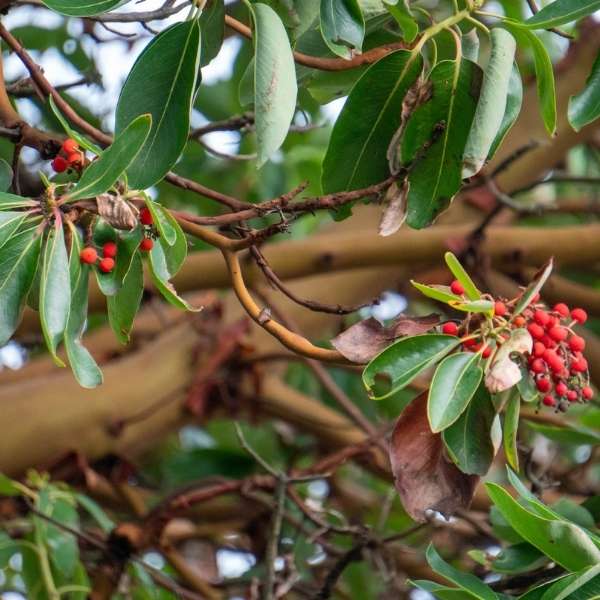
Pacific madrone is a broadleaf evergreen tree with rich orange-red bark that peels away on the mature wood, leaving a greenish, silvery appearance that has a satin sheen and smoothness. The exposed wood sometimes feels cool to the touch. In spring, it bears sprays of small bell-like flowers, and in autumn, red berries. Description from Calscape
Home > Plant Guide >
Scientific Name
Family
Garden Type
Wildlife
Native Plant Region
Light needs
Water Needs
Plant Type
Bloom Color(s)
Height
Width
Months in Bloom
Safe Beneath Power Lines?
We’d like to maintain accurate and robust plant listings. If you see information that is not correct or that could be added to improve the listing, please let us know. Or if you’d like to suggest a plant to add to our plant guide, you can use this form do so. Thank you!

Get involved by sharing and mapping the birds, animals and nature around you to help the community understand the biodiversity in our neighborhood.

Despite the urban character and the high population density, a surprising diversity of life exists in Capitol Hill. Explore a few physical aspects of our urban ecosystems and meet some of its more-than-human residents.

Seattle neighborhoods are full of wildlife and wild things. We’ve compiled a few exercises to help you slow down and appreciate the nature that surrounds you.

The plants, animals, fungi, microbes, and other natural features that make up “urban habitat” are important to the character, function, and livability of cities.

Take a virtual tour of Capitol hill with naturalist and author David B. Williams and gain a new appreciation of the nature of the city and its wild side.

New types of vegetation can attract additional wildlife to an area. You might be surprised how a little green can go a long way!
Nature of Your Neighborhood is a collaboration between Birds Connect Seattle, the Capitol Hill EcoDistrict, and the Seattle Bird Conservation Partnership. Our goal is to foster relationships between the people and the nature of their neighborhoods.